





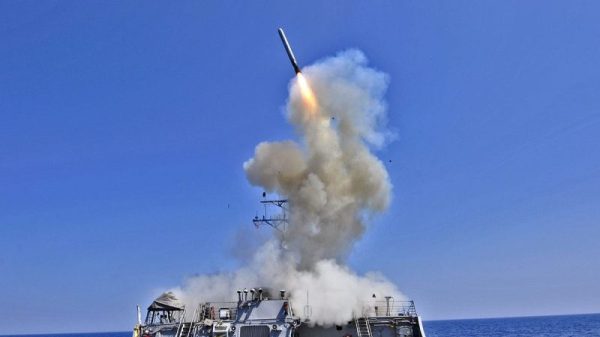



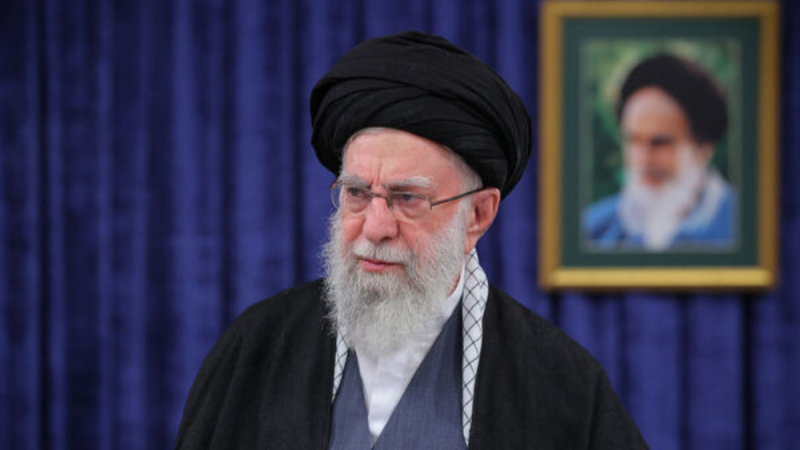
In a sweeping pre-dawn bombing campaign across Iran, Israeli forces targeted sites linked to Iran’s Supreme Leader Ayatollah Ali Khamenei, a senior Israeli official confirmed to Fox News. The official said Iran’s president was also targeted as part of the joint U.S. operation, dubbed Operation Epic Fury.
Reuters reported that Khamenei was not in Tehran during the strikes and was instead transferred to a secure location.
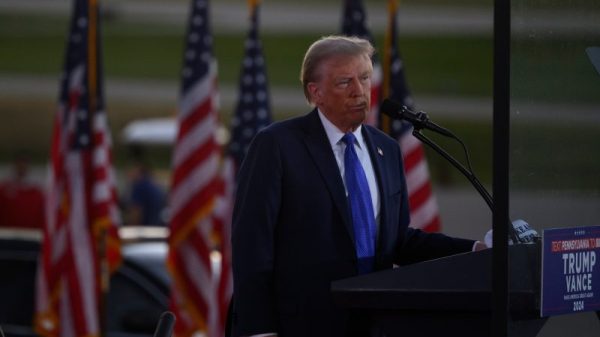
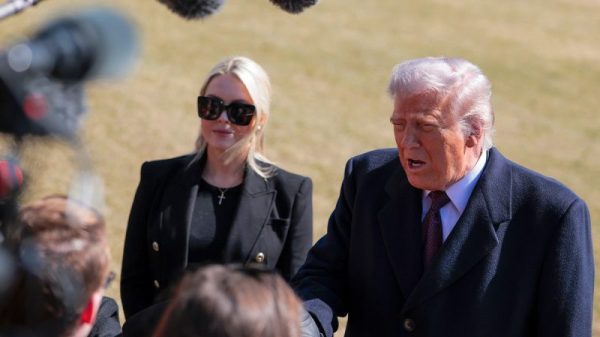
President Donald Trump described the ‘massive and ongoing’ operation as the opening phase of a campaign that he said would devastate Iran’s military, dismantle its nuclear program and ultimately bring about regime change.
‘It will be yours to take,’ Trump said in a video statement addressing the Iranian public.
Hours later, Tehran signaled it would not back down, saying it would defend itself against any attack.
‘This will be probably your only chance for generations,’ he added. Officials in Tehran said the country would defend itself against any attack.
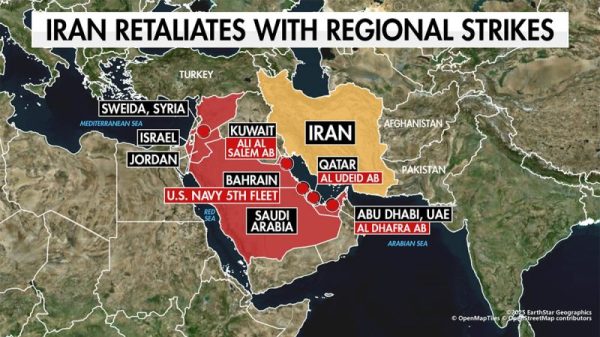
Ahead of the strikes, the U.S. military amassed what Trump previously called an ‘armada’ in Iran’s backyard. Mapped out across the Persian Gulf and beyond, the deployment tells its own story, one of calculated pressure backed by credible capability.
The buildup coincided with indirect negotiations between Washington and Tehran over Iran’s disputed nuclear program. Trump has warned that the regime must fully dismantle its nuclear infrastructure or face consequences.
At the heart of America’s force projection are the USS Abraham Lincoln and USS Gerald Ford aircraft carrier strike groups — dual mobile fortresses at sea, guarded by destroyers and equipped to unleash precision strikes at a moment’s notice.
More than a dozen other U.S. warships are also in the region to support.
For Iran, it means U.S. forces are not concentrated in a single vulnerable location — they are distributed, layered and positioned to operate from multiple directions at once.
It was not immediately clear how or when Iran might respond. But with senior leaders targeted and U.S. naval assets positioned across the region, the latest exchange marks one of the most volatile moments in the decades-long standoff between Israel, Iran and the United States.