


















The chances of a bipartisan solution to expiring Obamacare subsidies are growing slimmer with each passing day as the Senate gears up for a vote next week on extending the credits.
Senate Democrats made the subsidies the focal point of their position during the government shutdown, which ended only after a group of Democrats broke from Senate Minority Leader Chuck Schumer, D-N.Y., based largely on a guarantee from Senate Majority Leader John Thune, R-S.D., that lawmakers would get a chance to vote on extending the subsidies.
And next week is Thune’s deadline to get a proposal on the floor, but the likelihood that it is bipartisan is fast fading.
‘I mean, my assumption is that by next week, when we have to have that vote, that we might not be far enough along in the bipartisan discussions. But my assumption is we’ll still have a vote of some kind, because that’s what we’re committed to do,’ Thune said.
Bipartisan talks have been ongoing, both during the shutdown and in the weeks after. But those have yet to yield a plan that could muster the 60 votes necessary to break through the filibuster in the upper chamber.
Republicans want to see reforms to the program and are floating proposals that would see money from the subsidies that normally flows to insurance companies be sent directly to Health Savings Accounts (HSAs) — a plan previously floated by President Donald Trump.
Democrats, however, want a cleaner extension of subsidies but are open to reforms either up front or down the line.
Sen. Roger Marshall, R-Kan., told Fox News Digital he’s been involved in talks with colleagues across the aisle, but those discussions had recently slowed. He agreed that a bipartisan solution was likely out of reach by next week’s vote.
‘I mean, I would love to see that, but it’s not realistic, and I’m putting my eggs into the basket for Jan. 30, a nice bipartisan package,’ he said.
At that point, however, the subsidies will have expired.
That leaves the option of a possible side-by-side vote, with Democratic and Republican proposals put on the floor to see which survives. But that idea may not have much support, either.
‘I don’t know about whether they would have the appetite for a side-by-side,’ Sen. Tammy Baldwin, D-Wis., said. ‘We certainly have not seen Republicans come up with any sincere plans to help alleviate the concerns.’
Senate Health, Education, Labor and Pensions Chair Bill Cassidy, R-La., who is leading Republicans’ negotiations for a plan on the subsidies, scoffed that if Democrats spoke with him, ‘You’re going to be hearing a lot of sincerity.’
Cassidy’s plan revolves around HSAs, which he sketched out in broad terms to Fox News Digital. Under his plan, HSAs would be pre-funded with, ‘say $2,000,’ that he argued would see Americans pay roughly the same health insurance deductibles and act as a much more workable day-to-day policy moving forward.
He noted that Democrats see where he’s coming from, but that he couldn’t say if he’s got ‘their vote yet.’
‘If you look at the numbers, there are people who are in their 50s and 60s who will really, like, pay a third of their income for insurance on the exchange, and so the Democrats have set it up so there’s a cliff at the end of this year, and we’re trying to avoid that cliff,’ Cassidy said.
‘So [we’re] looking for a way that can take care of those folks but begin to transition to a system which is much more workable,’ he continued. ‘The Obamacare subsidy system is not workable.’
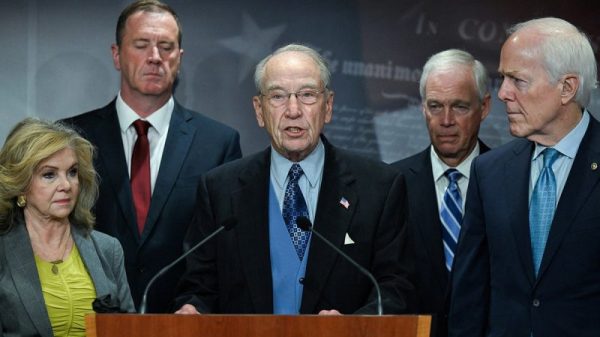
Cassidy and Senate Finance Committee Chair Mike Crapo, R-Idaho, pitched ideas and options during the Senate GOP’s closed-door lunch on Tuesday, but there still wasn’t a solid consensus on a path forward on a Republican proposal.
Sen. John Kennedy, R-La., said it would take ‘divine intervention’ for Republicans to agree on a plan to vote on by Thune’s deadline next week.
‘Have you ever heard of a Rorschach test where it’s smeared all over the wall? That’s kind of where we’re at,’ Kennedy said.
Members on both sides of the aisle believe that Trump should get more involved, too, given that anything that passes the Senate and works through the House would need his signature to become law.
Sen. Angus King, I-Maine, one of the eight Democratic caucus members that voted to reopen the government with Republicans, said that it would help if Trump told the Senate GOP to make a deal.
‘I think the easiest, clearest thing would be a straight extension with some modest reforms, and then we can move on,’ King said. ‘And frankly, if it doesn’t happen, then the Republicans can own massive premium increases. And I don’t know why they would want to do that.’